
Stöbern
genialokal zum Startbildschirm hinzufügen
Installieren Sie die genialokal App auf Ihrem Startbildschirm für einen schnellen Zugriff und eine komfortable Nutzung.
Installieren Sie die genialokal App auf Ihrem Startbildschirm für einen schnellen Zugriff und eine komfortable Nutzung.
Tippen Sie einfach auf Teilen:
 Und dann auf "Zum Home-Bildschirm [+]".
Ihr gewünschter Artikel ist in 0 Buchhandlungen vorrätig - wählen Sie hier eine Buchhandlung in Ihrer Nähe aus:

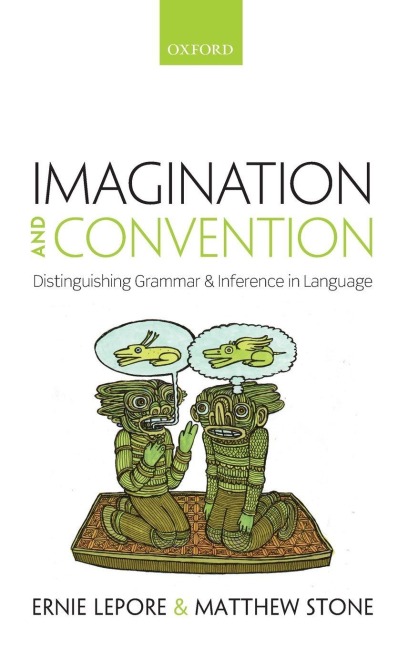
What do speakers mean? What do they convey? What do they reveal? How do they invite us to think? Communication exploits conventional rules, deliberate choices, and many other faculties. How? A common answer invokes simple meanings and general ways to reinterpret them, as in H. P. Grice's theory of conversational implicature. Lepore and Stone show such answers are unsatisfactory. Instead, they argue that language provides diverse tools for making ideas public, and that communication recruits distinct kinds of imagination. The work synthesizes results from across cognitive science into a profoundly new account of meaning in language.
Ernie Lepore is Board of Governors, Professor of Philosophy and an Acting Director of the Center for Cognitive Science at Rutgers.
Matthew Stone is Associate Professor in the Department of Computer Science and Center for Cognitive Science at Rutgers.
Preface
1: Overview
I: The Landscape of Pragmatic Inference
Introduction to Part I
2: The Gricean Framework
3: The Linguistic Turn
4: The Psychological Turn
II: The Interpretive Effects of Linguistic Rules
Introduction to Part II
5: The Scope of Linguistic Conventions
6: Speech Act Conventions: Indirection and Relevance
7: Presupposition and Anaphora: The Case of Tense and Aspect
8: Information Structure: Intonation and Scalars
Summary of Part II and Projection
III: Varieties of Interpretive Reasoning
Introduction to Part III
9: The Scope of Interpretive Reasoning
10: Perspective Taking: Metaphor
11: Presenting Utterances: Sarcasm, Irony, and Humor
12: Leaving Things Open: Hinting
Summary of Part III and Projection
IV: Theorizing Semantics and Pragmatics
Introduction to Part IV
13: Interpretation and Intention Recognition
14: Inquiry and the Formal Underpinnings of Communication
Conclusion
